
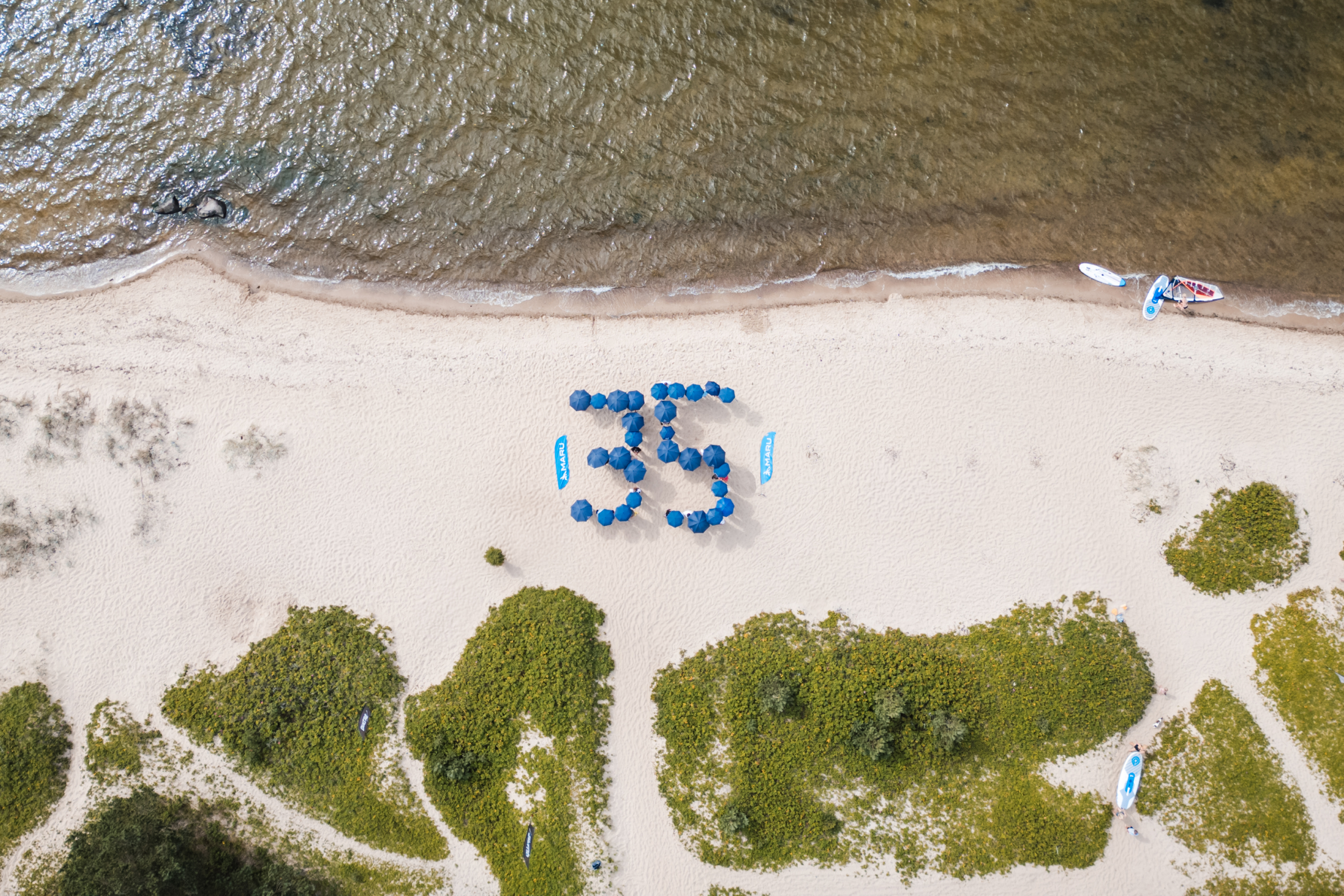
Today, 35 years ago, the public limited company “MARU” received its certificate of registration, which was issued by the Harju County Business Register on February 19, 1991.
The day before, the Harju County Government had granted Maru—which was operating at that time in the village of Riidamäe in Kõue Parish—a business license, authorizing the newly established company to engage in “the design, documentation, and execution of construction and renovation work,” as well as, among other things, “the production and sale of consumer goods” and “foreign economic activities” (see photo below the news item).
Today, the Maru Group has grown into a large construction and manufacturing conglomerate that employs nearly 400 people and is engaged in general contracting, design, installation, concrete work, business park development, steel production, and the development of PVC warehouses and mobile solutions. According to the latest annual report, the group’s revenue reached 100 million euros. The group’s companies include Maru Ehitus, Maru Metall, Maru Betoonitööd, Maru THM, MDSC Systems, and Moodul.
The students started making halls
Heiki Laiverik, a student of industrial electronics at TPI (now TalTech), laid the foundation for Maru’s activities when he ended up building an arched hall while serving in the work brigade. He was soon joined by his classmate Andres Piiber and his brother, Ain Laiverik—who was still a high school student at the time—and they worked on the project both alongside their studies and during summer breaks. Together, they built halls for years, while around them the Soviet Union began to collapse and Estonian entrepreneurship began to emerge. This is how the founders of Maru decided to start their own business.
As the business expanded, design and manufacturing were added to the construction of warehouses. When a significant number of general contractors joined the client base, Maru’s founders decided to begin operating as general contractors themselves. At the turn of the century, Maru established itself as a builder of large-scale projects.
Among the Maru Group’s projects is an impressive list of iconic Estonian structures: Saku Suurhall, the Tallinn Bank headquarters, the new KAPO building, the Kanama Viaduct, Tallinn Airport with its parking lot, the Kalevi Yacht Club marina building, all three of Estonia’s synchronous compensator stations, the Enefit oil plants, the VKG industrial complexes, the Elcogen fuel cell plant, the Neo Performance Materials magnet plant, and many others. Maru Ehitus has served as the general contractor for several of these projects, while for others, Maru companies have performed work such as concrete construction or steel framing.
Projects have also been completed abroad. A notable example is the list of sports facilities built abroad with Maru’s assistance, which includes soccer arenas in Iceland, the Riga Arena—the flagship arena of the Latvian capital—and the Helsinki Olympic Stadium. In Finland, for example, Maru has received orders from builders of schools, swimming pools, shopping centers, industrial facilities, and boiler houses.
Reflections from Maru’s founders on the company’s 35-year journey:
Andres Piiber: “We have tried to develop the business culture of the Republic of Estonia in such a way that everything is official and above board, and that the state also gets its share.”
Ain Laiverik: “A good entrepreneur is someone who is hardworking and disciplined. Life is a matter of chance, but you have to work to make sure that positive chance happens. Do your thing—and do it well! Be honest. Do what you promised.”
Heiki Laiverik: “Everything has been achieved through hard work. We’ve grown together as a team through adversity. I hope that Maru will continue to be a successful company that will one day have its own landmark in the form of its new building.”
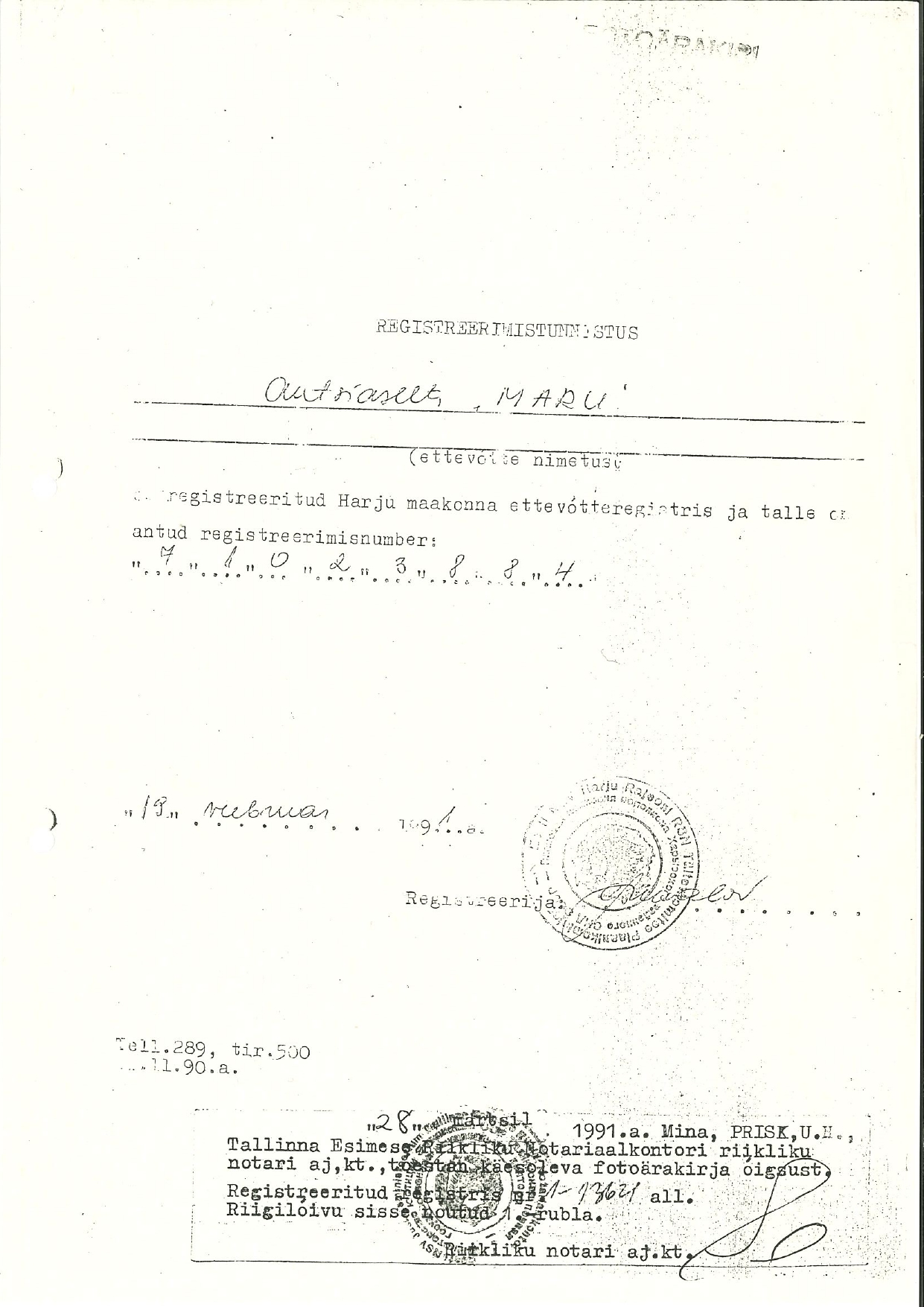
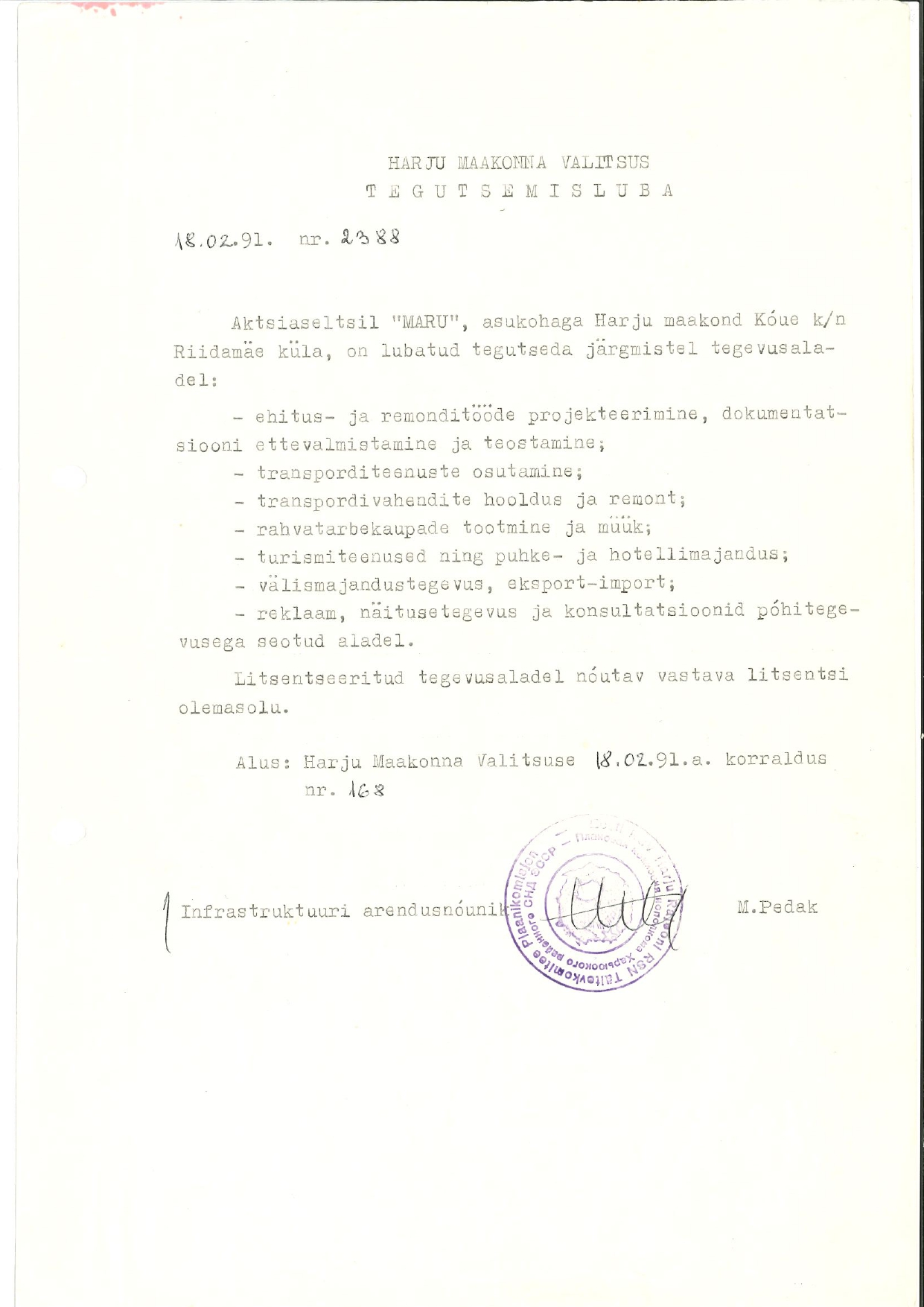
Maru’s Certificate of Registration and Operating License from 1991