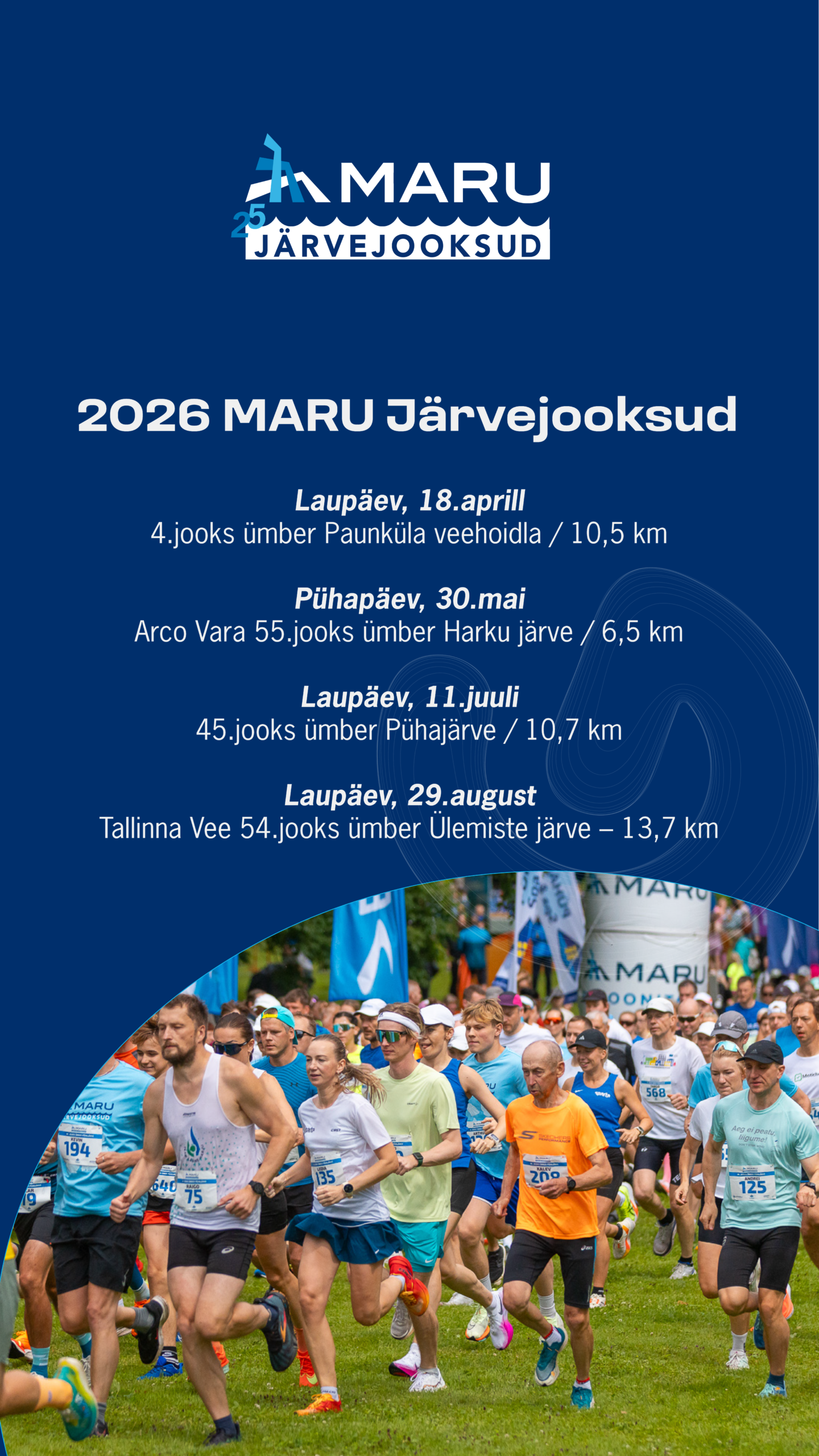
The history of the Lake Runs series includes colorful participants and “hellish” runs held in record-breaking heat, recalls Urmo Raiend, head of Stamina, who has organized the series for 25 years. According to Raiend, the Lake Runs have always motivated running enthusiasts to train consistently throughout the summer, and the anniversary year should bring together a record number of participants. Maru has been the title sponsor of the series for the sixth consecutive year.
Who talked you into becoming the chief organizer of the Lake Runs 25 years ago?
No one had to talk me into it. I had been organizing the run around Lake Ülemiste since 1995 and the Lake Pühajärve run since 2001. In 2002, we got the organizers of the Lake Viljandi run on board, and that’s how the Lake Runs series was born. In its first year, it consisted of three races: around Lake Viljandi, Lake Pühajärve, and Lake Ülemiste.
You’ve been leading this for a quarter of a century now! How have you managed to organize the same event for 25 years?
You could just as well ask how someone has done the same job for 25 years or more. I’m motivated by the positive feedback from participants and the opportunity to work outdoors in nature. As long as there are participants and supporters, we will keep going!
What is your first memory from the races?
I clearly remember the 30th run around Lake Ülemiste, which concluded the very first Lake Runs series. The winner was Pavel Loskutov, whom we had to work hard to recruit for the start. Loskutov, who had won European Championship silver in the marathon in Munich just two weeks earlier, finished more than a minute ahead of Vjatšeslav Košelev and Toomas Tarm (pictured below at the prize ceremony for that very race).
How has the series changed over time?
The core essence has remained the same, although the specific races included in the series have changed. The Lake Runs series was born in 2002 when the Grand Race around Lake Viljandi was joined with the Pühajärve and Ülemiste runs. The idea was to get running enthusiasts to train purposefully for nearly half a year and inspire newcomers to set bolder goals. Consistency is key to any meaningful activity, and that is guaranteed in this series.
In 2003, the Lake Harku run joined, making it a four-stage series. In 2013, the Viljandi run decided to leave the series, so we looked for a fourth race again. We chose the Saadjärve lap, and the first summer run around Lake Saadjärve took place in late July 2014. It turned out to be a “hell run”- finishers were collapsing and needed cooling down. To this day, the temperature of 35.4°C measured on July 27, 2014, remains the heat record for the start and finish area in Äksi.
The Saadjärve run was held six times, last in 2019. The Paunküla Reservoir run was added in 2022 to the Harku, Pühajärve, and Ülemiste runs, making the series four stages once again.
What has been the biggest challenge?
One major challenge is, of course, finding sponsors, including title sponsors. Since 2021, the title sponsor has been the Estonian construction group Maru, and I am deeply grateful to the company!
Over the years, various companies have stepped up as main sponsors, including Mayeri, EMT (the predecessor of today’s Telia), DFDS, and the media portal Delfi.
Sometimes, obtaining the permit for a public event is also a challenge. Once that’s secured, everything else is in the hands of the team. Parking is always a bit of a “problem child” because the competition centers by the lakes aren’t really designed for a large number of cars.
You hear from others about their brightest memories. What is yours?
The participation records stick in my mind. In 2010, we had records for the Harku and Ülemiste runs with 1,120 and 1,017 finishers, respectively. 2011 also saw two records: 996 runners finished Pühajärve, and 423 enthusiasts completed the entire series.
We’ve had very colorful participants, especially at Pühajärve, where athletes from different sports often compete. Estonia’s best cross-country and biathletes are regulars there. Indrek Tobreluts and Raido Ränkel have even finished in the top three.
In 2004, basketball star Martin Müürsepp took a lap around Pühajärve after a successful season with UNICS Kazan. He enjoyed the beautiful lake views while running with his friend Tair Tenno and the legendary skiing sisters Katrin and Kristina Šmigun.
Among the many basketball players who have participated, Valmo Kriisa has recorded the fastest time. The current President of the Estonian Olympic Committee, Kersti Kaljulaid, participated in the Ülemiste run in 2007 and 2010. After a long break, she returned to the Ülemiste track in 2020 while serving as the President of the Republic of Estonia.
What is the most special feedback you’ve heard from participants?
I often hear a phrase that sums it all up: “The Lake Runs in their well-known excellence!”
The four races in the Maru Lake Runs series all offer different emotions and distances. Spread over four months – starting in mid-April and ending in late August – they provide great motivation to train during the summer and use the series to prepare for an autumn marathon or half-marathon.
What advice would you give to someone considering joining the Lake Runs? Who would you like to see more of on the running trail?
To experienced runners, I’d say: come and enjoy Estonia’s beautiful lakes. For beginners or those wanting to improve their speed, I recommend checking out the special training plans on our website, authored by Sparta running coach Toomas Tarm, who has participated in the Lake Runs since the very first race.
How will you celebrate the 25th anniversary of the series?
I haven’t actually thought about it yet. But I hope that before the final stage of the anniversary season – the 54th Lake Ülemiste Run – some good ideas will come to mind that can be worthily implemented.
What is your big “Lake Run dream” that you hope will come true?
My big dream is to have over 1,000 finishers at every single race and for the series to one day celebrate its 50th anniversary.
The interview with Urmo Raiend was published in Marathon 100.
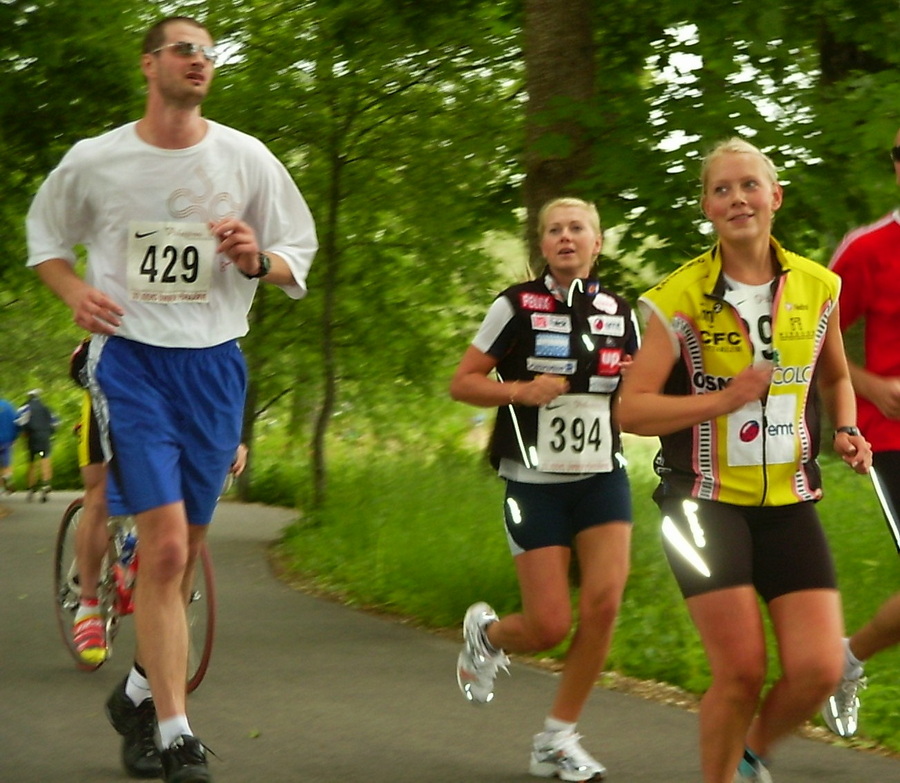
Basketball player Martin Müürsepp and cross-country skiers Katrin and Kristina Šmigun at the 2004 Lake Run.