
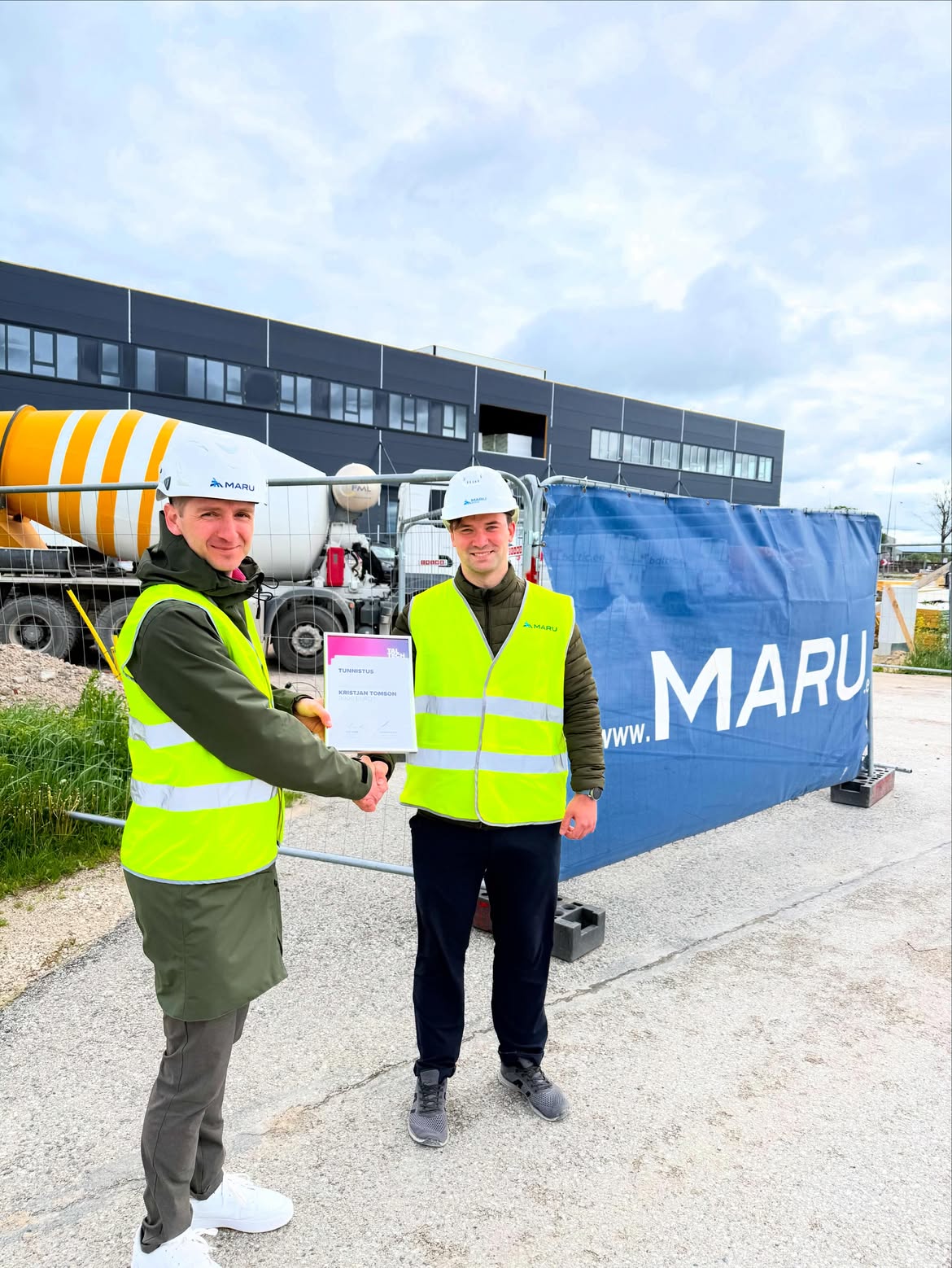
This spring, Maru Ehitus AS awarded its first scholarship—through the TTÜ Development Fund—to students in the field of construction at the Faculty of Engineering. CEO Margo Dengo explains the background:
Why did we decide to award this scholarship right now?
Working in the construction industry on a daily basis, we see that the shortage of qualified engineers is becoming more and more acute with each passing year. Therefore, we want to contribute to the next generation of engineers, and as several scholarship applicants wrote to us, the scholarship allows them to focus more on their coursework and thesis—which is exactly what they need to do during their time at university. It’s sad when, for financial reasons, students have to choose to work instead of studying, and sometimes end up leaving school altogether.
To answer the question of why we are offering this scholarship now, and why we didn’t do so earlier or later, I’ll quote the opening lines of Artur Alliksaar’s poem “Time”:
There are no better or worse times.
There is only the moment we are in right now.
Well, the time is right for us now, and we plan to continue awarding scholarships in the future as well.
How did this year’s scholarship competition turn out?
Since we also gave first-year students the opportunity to apply, we received a large number of applicants: 42 in total. It’s wonderful to see how many hardworking and bright-eyed students we have around us.
What was the deciding factor in your decision, and what advice would you give to students for future applications?
The selection process was truly very difficult because, as mentioned earlier, there were so many excellent candidates. This time, we decided to use an in-house “two-round” process, based on which we selected the three best candidates to interview. And based on those interviews, we chose the winner. What was the deciding factor:
- The ability to respond to the essay topic we have set in a concise and substantive manner.
- Positive letters of recommendation certainly played a role as well.
- Written communication skills and the visual language of an essay: in addition to what you say, how you say it is also important.
Congratulations to this year’s scholarship winner, Kristjan Tomson, to whom we presented a certificate of honor at our Bidfood construction site, since Kristjan was participating in the Kevadtorm military exercise during the formal ceremony. At the Bidfood site, we were greeted by site manager Marko Salumaa, who spoke to Kristjan about the practical realities of working on a large construction site. Kristjan also shared his thoughts with us:
Kristjan, you’re finishing your fourth year. Have you applied for scholarships before, and what is a student’s perspective on these types of competitions?
I have applied for scholarships from the Tallinn University of Technology Development Fund almost every semester. In addition, I have also applied for grants from several other scholarship funds. Generally speaking, scholarships are seen as an opportunity to earn extra money. That’s why I’ve applied everywhere I possibly could—you’ve got to give it a try.
In addition to the financial support, I see the Development Fund as an opportunity to compete with other students. As you mentioned, there were 42 candidates. Just for the thrill of the competition, it’s exciting to take part in something like this. Constantly applying for scholarships has, over time, helped me develop my ability to write better and more substantive letters of motivation and essays. My resume has also improved significantly over the years based on the feedback I’ve received.
If I have the opportunity to advance to the interview round, it will be very exciting to talk with other professionals in my field about specialized topics and shared interests. I dare say that applying for these scholarships has given me a great deal of valuable experience.
You also said that the scholarship helps you focus on your studies and your thesis. Could you briefly tell us what the topic of your thesis is and what problem you’re addressing?
In my thesis, I am conducting an in-depth study of the strength properties of finger-jointed glued laminated timber. The main objective of this work is to determine whether factory waste generated during the production of glued laminated timber could be used to manufacture new glued laminated timber. Preliminary tests have been promising.
Based on the results of the experiments, I would also like to develop a computational FEM model. I am doing this primarily out of personal interest—to program a more comprehensive model—but it could also be used to study the behavior of wood with varying strengths. For example, one could analyze whether, similar to factory waste, there is potential to use recycled wood in production.
I will certainly also investigate whether the production of finger-jointed glued laminated timber makes sense from both an economic and environmental standpoint. Although this approach allows for better utilization of wood, it is important to note that the production of finger joints requires more time and resources, including adhesive, tools, and electricity.
I would like to thank Maru Ehitust for awarding this scholarship, and I hope that this program will continue in the future.